
[:en]
Namibia: the destination in 2013 of Hege Helping Hands, a group of students from the Eppendorf grammar school in Hamburg. The boys and girls between 14 and 19 years of age spent three weeks in Namibia. They spent much of their time in the steps project in Gobabis, where they built a playground for the children.
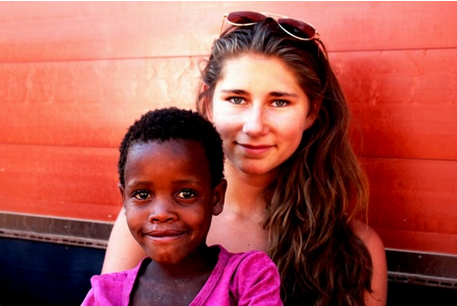
By Louisa Sara Schrum
The first thing I see is the morning sun. Like a fireball, it bathes the airport in glowing red light. We are instantly wide awake. Full of energy, we stumble down the gangway, a little in disbelief that we have finally made it, finally arrived.
A year of preparation lies behind us. During the weekly meetings outside lesson time, we spoke with guests from Namibia; we heard talks on infrastructure, wildlife and HIV infections. We collected donations, sold coffee, cake and raffle tickets, organised charity concerts – and in the end were delighted to have an incredible 10,000 euros for our project. Our project is in Gobabis. Gobabis is the capital of the Omoheke region, around 200 kilometres east of Windhoek. The town, with a population of 19,000, was established halfway along the Trans-Kalahari Highway to create an important stopover for traffic. A further 10,000 people live in the township of Epako. The destination of our journey! Here we want to build a playground for the children of the township in the steps for children project.
Now we are sitting on our suitcases and learning our first lesson: the bus that is supposed to take us to the project is not there. Nothing here can be planned and everything takes time. Tiredness creeps in – despite the excitement – we have been on our feet for 24 hours and huddle together in the only shady spot at nine o’clock in the morning, when it is already 25 degrees. It takes two hours. Then the buses arrive.
And we leave Windhoek on the only road leading to Gobabis. Along the entire route, we see nothing but endless drought, an almost endless horizon and not a single town, not even a small village. Only a few warthogs and dik-diks accompany us. No wonder, when you consider that the population density of Namibia is 2.25 inhabitants per km² and Namibia is two and a half times the size of Germany. Much of the land is uninhabitable because of the Namib Desert and the aridity.
What a joy it was when we arrived at the Goba Lodge. Lush vegetation, a pool filled with water and huge ostrich birds greeting us curiously with cooing sounds. Large, clean rooms. We had not hoped for such luxury. We enjoy carefree hours by the pool – they were to be the last hours of this kind for the next two weeks.
The following day, we set off with the vision of building a completely new playground.
Naturally, in Hamburg we had thought about how this could be done – however, we relied on the people on site having a construction plan.
That is where we were mistaken. There is nothing more than a drawing, which the project manager hands us with a friendly smile. One look across the large, dusty, rock-hard, fenced-in patch of ground that we are supposed to turn into a playground gives us an inkling that a good deal of work awaits us. But it is not only the merciless nature, with its blazing sun and rock-hard ground, that presents us with challenges, but also the roughly three hundred children. We are practically overrun by them. Aged between three and nine, they take possession of us with their openness, laughter and unbridled joy of life. In the first few days, a hole in the fence separating the school from the playground site becomes the greatest obstacle to orderly work.
Whenever the children are free from lessons, they crawl through the hole in the fence. And so playing with the children becomes an important part of our work too. We throw them into the air, play wheelbarrow, let ourselves have braids plaited, and are moved when three-year-olds, utterly exhausted from yet another sleepless, because too cold, night in the huts, fall asleep in our arms. In conversations with them, we hear about beatings at the state school, hunger and sexual abuse. They show us their scars and, a moment later, stand with us in a circle and teach us their dance games. In movement they seem to forget all horrors. They live in the moment. There is no yesterday and no tomorrow.
These encounters spur us on to forget our annoyance about the heat, missing or stolen materials and power cuts. We work in teams. From eight in the morning until four in the afternoon. With an hour’s lunch break. A schedule that only makes the locals smile. They stop at midday, when the sun reaches its highest point, and only start again at four, when it is no longer so hot. But we want to enjoy our evenings at the lodge, so we work flat out.
Some of us dug a total of 42 holes, 80 centimetres deep, in places using coffee cups. Others sawed 240 metres of South African hardwood by hand. 388 threaded rods were cut. Just as many holes were drilled and twice as many nuts tightened. 18 litres of paint were spread over wood and tyres. This resulted in six seesaws, a climbing frame, a climbing wall, a horizontal bar, a sandpit, a seating area, a slide, a tyre climb and a rope climb, as well as two slacklines. We dealt with power cuts, dismantled three drills, repaired the ageing cement mixer and bravely brushed off the first injuries. And we adapted to the mentality. We switched off, lived only in the moment. We sawed, swore, laughed – without being able to picture the finished result even remotely.
When the first seesaw was finished, we were rewarded! The children threw themselves onto it excitedly and rocked away without restraint. While in Germany one or two children sit on each side and do everything they can not to fall off, here five to ten children sit on each side and they are so keen to rock that they fall off.
On Sunday, two weeks after our arrival, it was finally done. Just in time for the opening, there stands a 12-metre-long climbing frame and six four-metre-long seesaws, nicely painted and safely installed on the new playground. The mayor of Gobabis comes, gospel choirs sing, a church service dedicates the playground, which is immediately stormed by children and adults alike. The laughing children on our frame show us that we have done it, we have reached our goal. We have built a playground and in doing so given the children something they can enjoy. We gained experiences that we would never have had at school or in Germany. And during this whole ceremony, it becomes clear to me that we would be leaving this wonderful place for now and that it is uncertain how things will continue there for the children.
The farewell is hard, but then the bus is waiting to take us north over the Waterberg Plateau into the famous Etosha Pan. On the very first safari day, which after the previous two weeks seems to us like an unreal fairy tale, we see lions and elephants at a waterhole. An absolute highlight! In that respect we are very lucky, as it does not often happen that you see a total of thirty animal species.
After two and a half days of safari, we set off towards Twyfelfontein, where we look at ancient rock paintings during a hike. Finally, we arrive in Swakopmund, the city where the influence of Germany’s colonial era can still be felt most strongly. Everywhere we encounter light-skinned people; some speak German, and one pastry shop even sells Black Forest cake. It all seems very artificial and out of place to me, just like little streams named Bismarck or Wilhelm II.
On our penultimate day in Namibia, we have one of our most beautiful experiences during a “Living Desert Tour”, on which we see chameleons, snakes and birds in the wild. Climbing up dunes and jumping down them is the most memorable experience of nature. In this moment, I feel, as so often on the trip, simply happy and completely free.
The most astonishing thing is that the Namib transitions practically seamlessly into the Atlantic and that the contrast between the dry sand and the roaring sea becomes unmistakable.
The next day had arrived, we had to pack our suitcases for the last time and drove back to Windhoek, where after a city tour we went back to the airport and said our goodbyes.
One topic that occupies us throughout the entire round trip is the stark contrast between the very luxurious hotels and the life we came to know in Gobabis. In Gobabis, people starve to death; in the hotels, food from the large buffets is often left over and thrown away.
In Gobabis, people long for water; in the hotels, water spills over from the pool and is taken for granted. In the townships, residents live together in corrugated-metal shacks in a very confined space, while on the other side there are only double rooms.
We often talk about it at length in the group; we do not have a solution to the problem. But we learn that one should appreciate and honor what one has more.
In the evening we leave Namibia on the last flight. Out of the window, I see the setting sun one last time, bathing the country in a fiery red light.
[:en]
Namibia: the destination in 2013 of Hege Helping Hands, a group of students from the Eppendorf grammar school in Hamburg. The boys and girls between 14 and 19 years of age spent 3 weeks in Namibia. Much of the time they spent in the steps project in Gobabis, where they built a playground for the children.
From Louisa Sara Schrum
The first thing I see is the morning sun. Like a fireball it bathes the airport in glowing red light. We are immediately awake. Full of energy we stumble down the gangway, a bit incredulous that we have finally managed to arrive.
A year of preparation is behind us. During the weekly meetings after school, we spoke with guests from Namibia. We heard lectures on infrastructure, wildlife and HIV infections. We collected donations, sold coffee, cake and raffle tickets, organized benefit concerts – and rejoiced in the end at an incredible 10,000 euros for our project. Our project, which is located in Gobabis. Gobabis is the capital of Omoheke region, about 200 kilometers east of Windhoek. The 19,000-strong community was built halfway along the Trans-Kalahari Highway to give the traffic an important mid-way stop. Another 10,000 people live in the township of Epako. The destination of our trip! Here we want to build a playground for the children of the township in the steps for children project.
Now we are sitting on our suitcases and learn our first lesson: the bus that will take us to the project is not there. Nothing here is predictable and everything takes time. Tiredness creeps in – despite the excitement – we have been on our feet for 24 hours and cluster together in the only shady place, since it is already 25 degrees at nine o’clock in the morning. Two hours it takes. Then the buses are there.
And we leave Windhoek on the only road that leads to Gobabis. On the whole route we only see endless drought, an endless horizon and not a single town, no small village. Only a few warthogs and dik-diks accompany us. No wonder, when you consider that the population density of Namibia is 2.25 inhabitants per km² and Namibia is two and a half times as large as Germany.
What joy when we arrived in the Goba Lodge. Lush vegetation, a water-filled pool and huge ostriches, who welcomed us with curious cooing. Large, clean rooms. So much luxury we had not hoped for. We enjoy carefree hours at the pool – they should be the last hours of this kind for the next two weeks.
We start the next day with the vision to build a completely new playground.
Of course, we had thought in Hamburg about how this could be implemented – but we had assumed that the people on the spot would have a plan.
There we were wrong. There is no more than a drawing which the project manager handed over to us with a friendly smile. A look over the large, dusty, rock-hard fenced-in plot of land on which we should build a playground, tells us that considerable work awaits us. But not only the merciless nature, with the scorching sun and the rock-hard ground poses tests, but also the three hundred children. We are virtually overrun by them. Between three and nine years old they beguile us with their openness, their laughter, and their irrepressible vitality. A hole in the fence that separates the school from the playground area will be the biggest obstacle to our work in the first few days.
Whenever the children have no classes, they crawl through the hole in the fence. And so playing with the children will be an important aspect of our work. We throw them up in the air, play wheelbarrows, plait braids and are moved when completely over-tired three year olds fall asleep in our arms after having had a sleepless night in their cold huts. We hear from them of beatings in the state school, hunger and sexual assault. They show us their scars and a moment later they put us in a circle and dance for us. In the movement they seem to forget all the horrors. They live for the moment. There is no yesterday and no tomorrow.
These encounters spur us on to forget about heat, missing or stolen material and unreliable power. We work in „gangs“. From eight in the morning to four in the afternoon. With an hour for lunch. A schedule that the locals can only smile at. They stop at noon, when the sun reaches its highest point and start again at four, when it is not so hot. But we want to enjoy our evenings at the lodge, so we work through.
Some dig a total of 42 holes, 80 centimeters deep, some of them made with coffee cups. While others saw through 240 meters of South African hardwood by hand. 388 threaded rods are sawn. The same number of holes are bored and twice as many nuts are tightened. 18 liters of paint are put on wood and tires. This creates six see-saws, a climbing frame, a climbing wall, a horizontal bar, a sandbox, a seating area, a slide, a tire staircase and a rope entrance and two slacklines. We cope with power cuts, dismantle three drills, repair the decrepit cement mixer and bravely ignore the first injuries. And we adapt to the mentality. We switch off, just living in the moment. We saw, curse, laugh – and can only guess at the end result.
When the first see-saw is finished, we are rewarded! Excited, the children rush out and without hesitation bounce away uncontrollably. Whereas in Germany one or two children would sit on each end and do everything to make sure that the didn’t fall off, here between 5 and 10 children sit on each end and they are so excited by the bouncing that they fall off.
On Sunday, two weeks after our arrival, it is then finished. There, in time for the opening is a 12 metre long climbing frame and six four-metre-long see-saws, beautifully painted and securely mounted on the new playground. The Mayor of Gobabis comes, gospel choirs sing and a church service inaugurates the playground, which is immediately stormed by children and adults alike. The laughing children on our equipment show us that we did it, we have achieved our goal. We have built a playground and so we have given the kids something about which they can be happy. We had experiences that we could never have had in school or in Germany. And during this whole ceremony it becomes clear to me that we would now leave this wonderful place and it is uncertain how it will be from now on for the children.
The farewell is difficult, but then the bus waits to take us north over the Waterberg Plateau to the famous Etosha Pan. On our very first safari day, which after the past two weeks feels like an unreal fairy tale to us, we see lions and elephants at a waterhole. An absolute highlight! In this respect we are very lucky, because it does not often happen that one sees a total of thirty species.
After two and a half days safari we depart towards Twyfelfontein where we look at ancient rock paintings during a hike. Finally, we come to Swakopmund, the city where the greatest influence of Germany from the colonial period can still be felt. Everywhere we encounter fair skins, some speak German and a pastry shop even sells Black Forest Gateau. To me all this seems very artificial and inappropriate, as well as small streams with names like Bismarck and Wilhelm II.
On our penultimate day in Namibia we make one of the most beautiful experiences, where we see chameleons, snakes and birds in the wild during a „Living Desert Tour“. The climbing and jumping off of dunes is the most memorable nature experience. At this moment, I feel, as so often on the trip, just happy and completely free.
The amazing thing is that the Namib merges virtually seamlessly into the Atlantic, and the contrast between dry sand and raging sea becomes clear.
On the next day it was time to pack our bags for the last time and drive back to Windhoek, where after a city tour we again drove to the airport and bade farewell.
One issue which occupies us on the whole tour, is the great contrast between the very luxurious hotels and the life which we got to know in Gobabis. In Gobabis people are going hungry while in the hotels food is left over from the great buffets and is thrown away.
In Gobabis people yearn for water while in the hotels water spills from the pool and is taken for granted. In the townships residents live in shacks in very confined spaces and on the other side there are only double rooms.
In the group we talk long and often about it but we don’t have a solution to the problem. But we learn that what one has, one should appreciate more and honour.
We leave Namibia in the evening with the last plane. From the window I see for one last time the setting sun, which bathes the land in glowing red light.
[:]
One Response to Namibia – land of contrasts