[:en]
In mid-August, we said goodbye to our four weltwärts volunteers Janna, Lisa, Katharina, Sophia and Patrizia – she was there for three months. For a year, they devoted themselves to our projects in Gobabis and Okakarara with a great deal of heart and energy, and here they describe in three words what was special about this time and how working and living in Namibia affected them.
Okakarara
Katharina: UNFORGETTABLE – HEREROS – SHARP
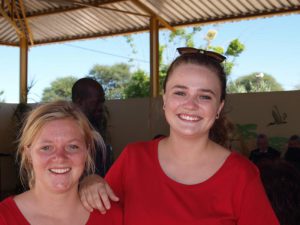 UNFORGETTABLE: For me, the decision to spend the year here was certainly one of the best I have made so far, and I am infinitely glad to have been able to experience it. So many experiences, people met, things learned. Had so much luck with so much (steps, Okakarara, Phia as fellow volunteer, Sonja as boss, etc.) that one often can hardly believe it!
HEREROS: Both our work and personal lives here are incredibly strongly shaped by Herero culture, and many of the problems and behaviors can be traced back to Herero culture. Over the year, we experienced 100% Herero culture and can now better understand and even anticipate many of the problems that arise, and we also discovered a few things that we Germans could perhaps learn from…
SHARP: Sharp is a South African expression meaning “super, okay,” which we have now integrated into our everyday vocabulary. Whether a task has been completed, the weekend plans are set, or the kids have done something well again, basically anything can be “sharp”! And the last 12 months were definitely sharp too!
Sophia: COMFORT ZONE – KATHI – TJIRUMBU
COMFORT ZONE: in the sense of leaving it and daring to try something new and look beyond the end of your nose.
KATHI: because she was there almost the entire year, 24/7, and without her it certainly wouldn’t have been nearly as lovely.
TJIRUMBU: is Otjiherero and means something like „white person“. We were shouted this after us day in, day out, and it stands for the cultural differences that have to be overcome.
Patrizia: CONTRAST – KAPANA – PETOSHA
 CONTRAST: If you spend a weekend in Windhoek with its huge malls, which are just as modern as large shopping centres in Germany, and the next in a traditional village without electricity and running water, you can hardly believe that all of this is the same country.
KAPANA: The food that local women sell by the roadside represents for me part of the Herero culture as I came to know it: food, and almost exclusively meat and carbohydrates (maize porridge or noodles).
PETOSHA: The children in the project had trouble pronouncing my name or remembering it; in trying, they came up with all sorts of funny versions of “Patrizia,” including “Petosha.” Phia and Kathi then called me that for three months, which is why I will certainly never forget this word.
Gobabis
Janna: OUTER EXPANSES – INNER DEPTHS
A year in Namibia, initially almost impossible to get through and ultimately too short. I never would have expected a country to captivate me so completely with its diversity, its landscape, and its people, who are so open and friendly—something I have never experienced anywhere else.
I learned an incredible amount, not only about raising children, Namibia’s culture, and how to make Fatcookies, but above all about myself. Who I am, who I want to be, and where I want to go in life.
It has been like a long journey to myself, accompanied by wonderful people, exciting work that presented new challenges every day, and the beauty of Namibia.
Namibia has become a “home away from home” for me.
Lisa: MADISA – UP AND DOWN – SURPRISE EGG
 MADISA: means “Hello, how are you?” in Khoekhoegowab. It is also the language spoken most widely in our project. Whether in English or in Khoekhoegowab (the language spoken by most of the children at our preschool), when greeting one another, people ask how you are—even if, for example, they merely meet on the street. I think this shows a special kind of openness that does not exist in Germany in this way. This greeting has simply become part of everyday life by now and has become a habit for me.
UP AND DOWN: That’s how it was here in Namibia throughout my year. There were many ups and downs, especially in the project work, with the initial homesickness and in my own feelings.
SURPRISE EGG: Everyday life in Namibia, with all its facets, is like a giant surprise egg. You never know what to expect on that day.
Without spontaneity, flexibility, adaptability and improvisation, many moments would not have become so unforgettable and beautiful.
Thank you very much for your wonderful and empathetic commitment!
Your steps team
[:en]
In mid-August, we said goodbye to our four weltwärts volunteers Janna, Lisa, Katharina, Sophia and Patrizia – she was there for three months. For a year, they devoted themselves to our projects in Gobabis and Okakarara with a great deal of heart and energy, and here they describe in three words what was special about this time and how working and living in Namibia affected them.
Okakarara
Katharina: UNFORGETTABLE – HEREROS – SHARP
UNFORGETTABLE: For me, the decision to spend the year here is certainly one of the best I have made so far and I am immensely happy to have had this experience. So many experiences, met people, learned things. We have been so lucky with so many (steps, Okakarara, Phia as fellow volunteer, Sonja as boss, etc) that we often can not believe it!
Herero: Both our work and personal lives here are incredibly strongly shaped by Herero culture, and many of the problems and behaviors can be traced back to Herero culture. Over the year, we experienced 100% Herero culture and can now better understand and even anticipate many of the problems that arise; we also discovered a few things that we Germans could perhaps learn from…
SHARP: Sharp is a South African expression meaning “super, okay,” which we have now integrated into our everyday vocabulary. Whether a task has been completed, the weekend plans are set, or the kids have done something well again, basically anything can be “sharp”! And the last 12 months were definitely sharp too!
Sophia: COMFORT ZONE – KATHI – TJIRUMBU
COMFORT ZONE: leaving your comfort zone in the truest sense of the word and daring to think outside the box.
Kathi: because she was there most of the year 24/7 and it certainly would not have been so beautiful without her.
TJIRUMBU: is Herero and means something like “white.” We were called this day after day here, highlighting the cultural differences that have to be overcome.
Patrizia: CONTRAST – KAPANA – PETOSHA
CONTRAST: If you spend a weekend in Windhoek with its huge malls that are just as modern as the large shopping centres in Germany, and then the next in a traditional village with no electricity or running water, you can hardly believe that this is all the same country.
Kapana: The food that local women sell me at roadside stands as part of the culture of the Herero, as I got to know it: food, almost exclusively meat and carbohydrates (corn porridge or noodles).
PETOSHA: The children in the project had trouble pronouncing my name or remembering it; in trying, they came up with all sorts of funny versions of “Patrizia,” including “Petosha.” Phia and Kathi then called me that for three months, which is why I will certainly never forget this word.
Gobabis
Janna: OUTER EXPANSES – INNER DEPTHS
A year in Namibia, initially almost impossible to get through and ultimately too short. I never would have expected a country to captivate me so completely with its diversity, its landscape, and its people, who are so open and friendly—something I have never experienced anywhere else.
I learned an incredible amount, not only about raising children, Namibia’s culture, and how to make Fatcookies, but above all about myself. Who I am, who I want to be, and where I want to go in life.
It has been like a long journey to myself, accompanied by wonderful people, exciting work that presented new challenges every day, and the beauty of Namibia.
Namibia has become a “home away from home” for me.
Lisa: MADISA – UP AND DOWN – SURPRISE EGG
MADISA means “Hello, how are you?” in Khoekhoegowab, which is the language most commonly spoken in our project. (Most of the children speak the language at preschool.) Whether in English or Khoekhoegowab, people ask how you are when greeting you—even if they have only encountered you on the street, for example. I think it is a special kind of openness that is not found in Germany. This greeting has simply become part of everyday life for me, and I have got used to it.
UP AND DOWN: My year in Namibia went like this. Especially in the work in the project, with the initial homesickness and within my own feelings, there were many ups and downs.
Surprise: Everyday life in Namibia in all its facets is like a huge surprise. You never know what to expect on this day.
Without spontaneity, flexibility, adaptability and improvisation many moments would not have been so memorable and beautiful.
Thank you for your wonderful and empathetic commitment!
Your steps team
[:]